Natural Builders | Wildfire Resiliency Series, Part 2
In the first post in this series, we covered the science of how wildfires actually spread — and why most homes in the wildland-urban interface are more vulnerable than their owners realize. If you haven’t read it, the short version is this: it’s rarely the flames that destroy a home. It’s embers, radiant heat, and the materials and conditions we’ve been overlooking for years.
This post is about what that means for you, practically, as a homeowner in Summit County. Three things specifically: what’s happening with insurance, how to honestly evaluate your own property’s risk profile, and what you can do about it — some of it today, some of it as part of a longer plan.
The Insurance Picture Is Getting Harder to Ignore
If you haven’t felt pressure from your insurance carrier yet, you likely know someone who has. Colorado’s homeowners insurance market has been under significant strain since the Marshall Fire destroyed more than 1,000 homes in Boulder County in December 2021. What followed was a familiar pattern: carriers repriced risk upward, restricted new policies in high-exposure areas, and in some cases stopped renewing existing coverage entirely.
Summit County hasn’t been hit as hard as Boulder or El Paso counties — yet. But the resort corridor carries its own compounding challenges. Second-home and vacation properties often face seasonal vacancy clauses. Replacement costs in mountain communities are genuinely higher. And carriers are increasingly applying their own risk models to determine insurability — models that look at slope, vegetation density, structural materials, and proximity to forested land, not just whether a home is technically inside a WUI boundary.
The numbers are real. In the Breckenridge, Frisco, Silverthorne, and Vail corridor, average homeowner premiums have climbed from roughly $2,500–$4,500 before the recent wave of wildfire losses to $5,500–$11,000 in 2024–2026 — and that’s for homeowners who can still get coverage at all. Colorado now has a FAIR Plan for homeowners who can’t secure policies on the standard market, but landing there is a sign of how dramatically the landscape has shifted.
The good news — if you can call it that — is that proactive mitigation can make a meaningful difference. Homeowners who create defensible space, upgrade to fire-resistant building materials, and maintain their properties throughout the year are better positioned both for safety and for continued eligibility in the standard insurance market. Whether that translates into a lower premium depends on the carrier and their methodology, but it increasingly determines whether you get coverage at all.
One important nuance: insurance companies use their own tools and maps to assess risk — separate from the state’s Wildfire Resiliency Code map. What the CWRC requires for new construction doesn’t automatically determine how a carrier rates your existing home. That assessment is happening on their terms, and understanding what they’re looking at is worth your time.
Reading Your Own Property’s Risk Profile
Most homeowners in Summit County have never done a systematic walkthrough of their property from a wildfire perspective. That’s not a criticism — it’s just not something that was on the checklist when most of these homes were built. The code didn’t require it, and the urgency wasn’t as visible.
It’s worth doing now. Here’s what to actually look at:
Start at the foundation and work outward.
The 0–5 foot zone immediately surrounding your home is the highest-leverage place to focus. The basics: remove dry materials within five feet of the home and under decks, porches, and sheds; keep leaves and needles off your roof and out of gutters; and make sure firewood is stored at least 30 feet away. These aren’t complicated, but they’re the most common failure points on properties that burn.
Look up at your roof and eaves.
Roof type matters — metal and Class A asphalt perform significantly better than wood shake under ember exposure. But condition matters just as much as type. Gaps in flashing, cracked or missing shingles, and accumulated pine needle debris in valleys are all ignition risks independent of what the roof is made of. If you can’t safely access your roof, this is worth paying someone to assess.
Look at your vents and soffits.
Attic vents are one of the primary ways embers enter a structure and ignite a home from the inside out. Standard mesh screens are not adequate — the openings are too large. Ember-resistant venting with fine mesh is a relatively low-cost upgrade that addresses one of the most documented ignition pathways.
Look at what your siding is made of and how it’s holding up.
Siding type is generally less important than condition — cracks, gaps, age, and rot all create potential entry points for embers regardless of material. Cedar and wood siding common in older Summit County homes is particularly worth evaluating carefully. If it’s showing its age, it’s showing its vulnerability.
Look at what connects to your home.
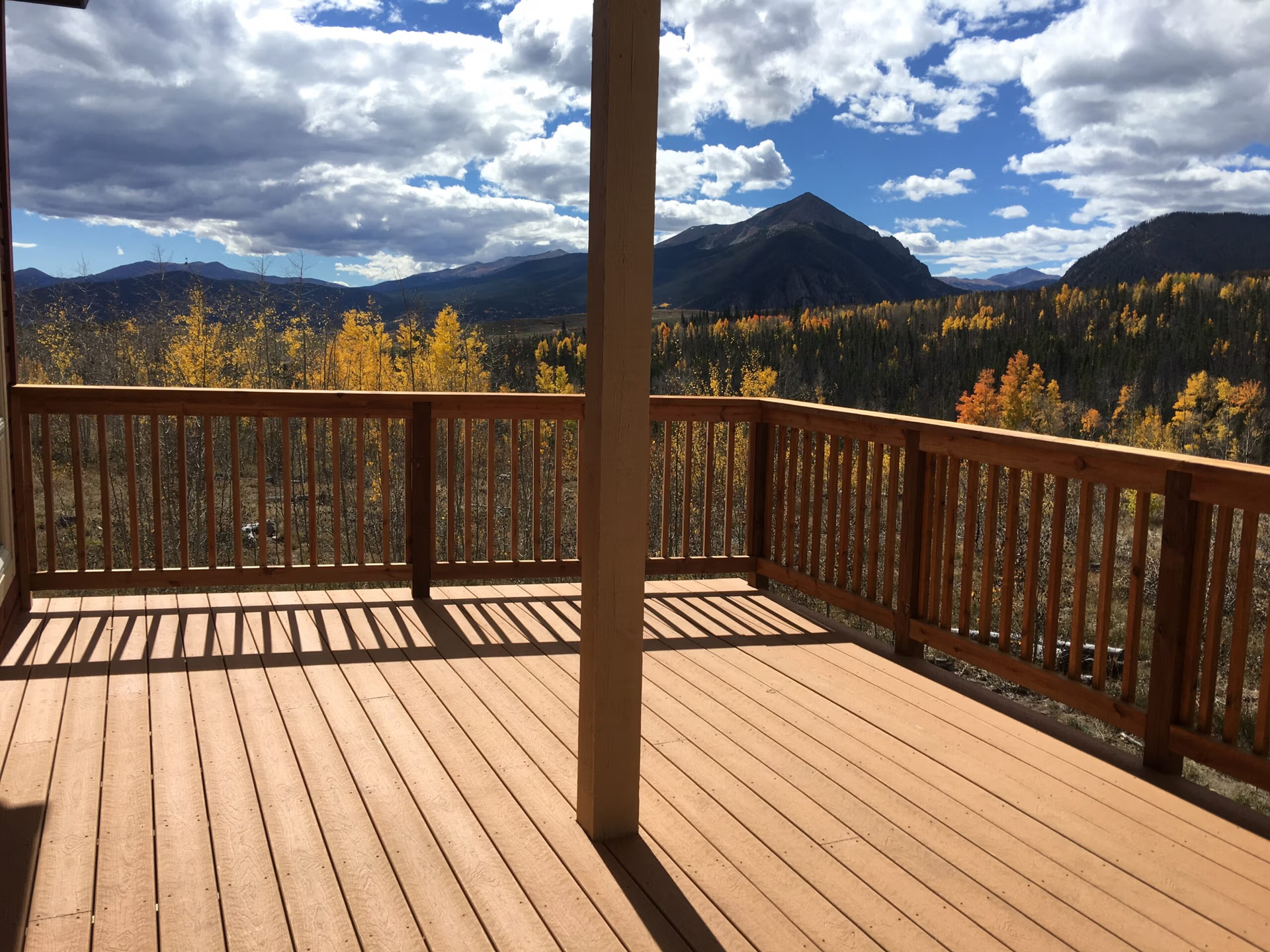
Wood fences attached directly to a structure can act like a fuse — if the fence ignites, fire has a clear pathway to the home. Similarly, a wood deck built directly against combustible siding, or with open space underneath that accumulates debris, is a significant risk that often goes unaddressed.
Look at your lot’s slope and vegetation.
Fire moves uphill rapidly. A steeply pitched lot with dense conifer growth creates a fundamentally different risk profile than a flat lot with good clearance. At least 23,000 properties in Summit County are at recognized wildfire risk — if you’re in a forested neighborhood, particularly one with south or west-facing slopes, assume your property is among them until you have information that says otherwise.
Get a Free Assessment — Then Know What to Do With It
Both Summit Fire & EMS and Red, White & Blue Fire offer free, no-obligation home wildfire assessments for existing homes. A wildfire specialist will walk your property with you over the course of about an hour, covering defensible space, home hardening against embers, and material considerations for decks, siding, and roofs.
This is worth doing, and worth doing soon. The numbers for Summit Fire are 970-262-5100; for Red, White & Blue, 970-453-2474.
What these assessments give you is a prioritized picture of your property’s vulnerabilities. What they generally don’t give you is a clear path to addressing the structural ones — the materials and construction elements that require a contractor, a permit, and in some cases an engineer. That’s where the assessment becomes a starting point rather than an endpoint.
Summit County also runs a Chipping Program: if you clear conifer and aspen from around your home and stack it in a slash pile, the county will chip it and haul it away for free. Hazardous Fuels Reduction grants are available for homeowner groups working across multiple properties. These programs exist because the county understands that individual action matters at scale — a well-mitigated home in a neighborhood of vulnerable ones is still a home at risk from radiant heat.
What You Can Actually Control
It helps to think of wildfire resilience as a layered system, not a single upgrade. Some layers are cheap and immediate. Some require planning and investment. Here’s a practical framework:
Do these now, no contractor required:
- Clear combustible material from Zone 0 (the 0–5 foot perimeter)
- Remove pine needle and leaf debris from gutters, roof valleys, and deck surfaces
- Move firewood and propane tanks to compliant distances from the structure
- Cover attic and crawlspace vents with fine wire mesh if they aren’t already
- Subscribe to Summit County Alert at SCAlert.org for emergency notifications
- Know your evacuation routes — at least two of them
Plan for these in your next maintenance or remodel cycle:
- Roof assessment and, if warranted, replacement with Class A materials
- Siding evaluation — particularly if your home has aging wood or composite products
- Deck material and configuration review, especially for decks with open undersides or combustible surfaces attached to the structure
- Ember-resistant vent replacement
- Window upgrades to tempered glass if current glazing is single-pane or degraded
Consider as part of a longer-term investment:
- Comprehensive exterior hardening to CWRC standards — especially relevant if you’re planning an addition or significant remodel, which now triggers the new code requirements
- Defensible space improvements that extend into Zone 1 and Zone 2
- Landscape redesign that reduces fuel connectivity between your home and the surrounding forest
The Remodel Trigger Worth Understanding
One detail that surprises a lot of homeowners: under Summit County’s newly adopted fire codes, certain additions and remodels now trigger requirements that didn’t apply to your home when it was originally built. If a project increases your home’s footprint to over 4,500 square feet, or if you’re remodeling more than 50% of the floor area of a home already over that threshold, sprinkler system requirements may apply. And any project requiring a permit issued after May 4, 2026 must meet the Colorado Wildfire Resiliency Code exterior material standards.
That’s not necessarily a reason to put off a project — but it’s a reason to understand exactly what your project will require before you start planning it. The scope of work, the permit type, and the materials you choose all interact in ways that are worth mapping out early.
In the final post in this series, we’ll get into the materials themselves — what’s available, how they perform in mountain conditions specifically, and how Natural Builders is approaching the question of building and renovating in the WUI era.
Natural Builders is a premium residential remodeling company based in Silverthorne, Colorado, serving Summit County and the surrounding resort corridor.